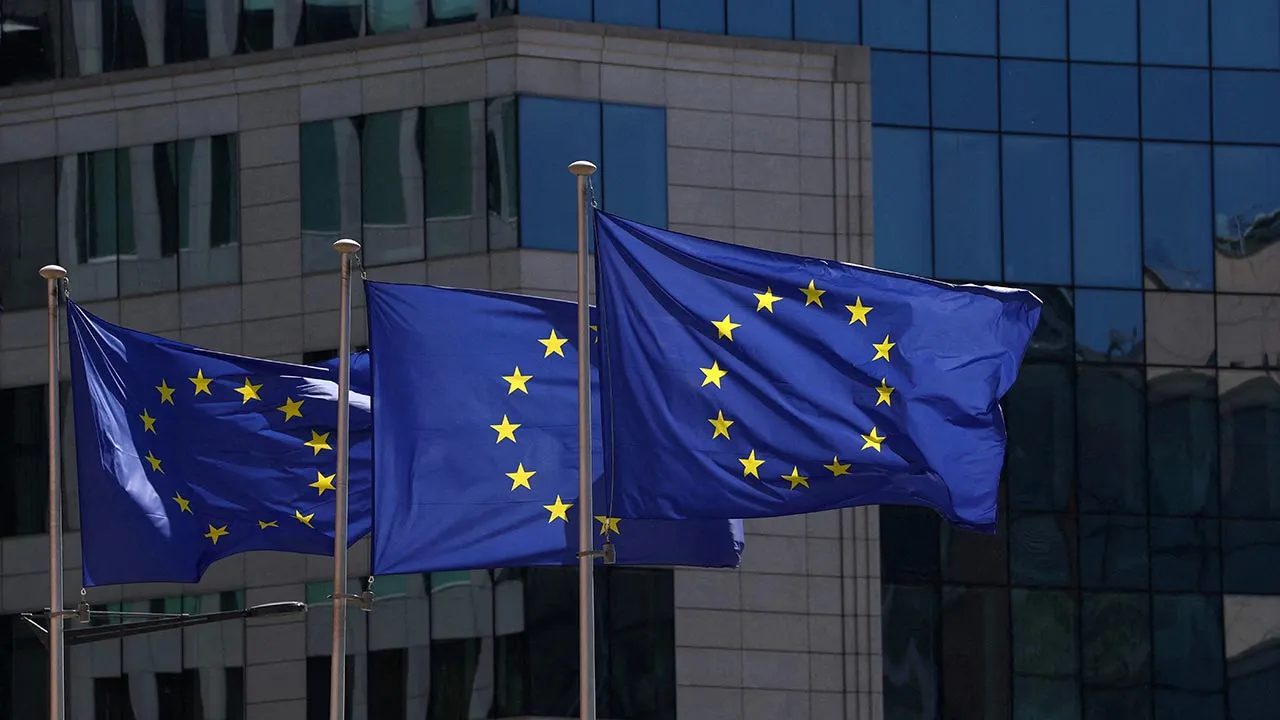
Published by AstroAwani, image by AstroAwani.
At the annual gathering of French business leaders in Paris on 27 August, European Commission President Ursula von der Leyen pitched the Savings and Investments Union to unlock €470bn from Europe’s “lazy” €10tn private savings for companies.
The language was bound to provoke as a bank balance accumulated as safety cushion through years of work does not readily appear “lazy” to the person who owns it. Yet the controversy should not be reduced to its most sensational interpretation, and one must look deeper.
European savings have not become idle. It rather appears that Europe has created such a large gap between its strategic ambitions and its available public resources that it is now trying to turn the cautious saver into an investor, and private financial security into a source of risk capital.
That is, the correct question therefor should be: what exactly were the decisions that produced this gap, who determined the hierarchy of expenditures, and why are households being asked to bear the financial consequences? What is important, here It is no longer sufficient to reply that investment is normally undertaken by the private sector. What is contemplated is a deliberate, state-driven change in the channels, incentives and rules through which private capital is allocated.
Even economically, deposits are not dormant as they help fund bank balance sheets, which in turn support lending to households and businesses.
Nor a household deposit is idle from the perspective of the saver as it supplies liquidity, preserves nominal capital and provides a defence against unemployment, illness, family emergency or political uncertainty. Its lower return is partly the price paid for accessibility and reduced risk. This very distinction matters because the proposed transformation changes the location of risk.
Households moving from protected deposits into investment funds, equities, securitised assets or supplementary pension vehicles may earn higher long-term returns, but they also absorb market volatility and potential losses. While European companies receive capital, financial intermediaries collect fees and governments shift its responsibility in advancing industrial objectives it is ordinary savers who bear potential downside of this.
Europe unquestionably faces an investment problem. The Commission’s Savings and Investments Union strategy cites Mario Draghi’s estimate that the European Union requires an additional €750 billion to €800 billion in investment every year by 2030. European start-ups often struggle to scale at home; capital markets remain divided by national regulation, taxation and insolvency regimes; productivity growth is weak; energy costs remain painfully high; and a considerable portion of European capital finds deeper, more liquid and often more rewarding markets elsewhere, especially in the United States.
These facts produce yet another uncomfortable question. If European investments are sufficiently attractive, why must political institutions campaign to alter the behaviour of depositors? Capital leaving Europe is not evidence of deficient continental loyalty. It is information about expected returns, risk, liquidity, technological dynamism and confidence in policy.
Therefore, redirecting savings may temporarily increase the volume of finance available, but more capital passing through an unreformed system cannot by itself make an uncompetitive investment productive. It may instead inflate asset prices, expand financial intermediation and conceal the institutional causes of Europe’s malaise.
Furthermore, securitisation improperly calibrated can lengthen the distance between lender and borrower, increase opacity and transmit losses across an interconnected financial system. The European Trade Union Confederation has noted that 84 per cent of EU securitised assets in 2023 were held by banks and sold to other banks. The pertinent test is therefore whether securitisation produces affordable financing for productive businesses or merely circulates assets and risk within the financial sector. Released capital might finance small firms, but it might also remain as liquidity, fund shareholder distributions or be absorbed elsewhere. “Unlocking” capital does not automatically equate directing it towards a measurable public benefit.
The deeper difficulty is that Europe’s investment deficit now sits beneath an expanding architecture of various strategic commitments. The green transition, digital infrastructure, artificial intelligence, energy security and industrial renewal already required sums that Europe’s fragmented fiscal and financial system was struggling to provide.
The Commission’s itself acknowledges that Draghi’s estimate is further affected by rising defence requirements. The war in Ukraine and accelerated rearmament did not create Europe’s structural weakness, but they have become formidable fiscal accelerants.
Since 2022, the EU and its member states have mobilised approximately €220.2 billion in military, financial, humanitarian and other support for Ukraine, according to the Commission. A further €90 billion Ukraine Support Loan has been established for 2026 and 2027, with roughly €60 billion allocated to military assistance.
Europe is also increasing its own military expenditure while the United States presses its allies to carry more of the burden, even though European military support remains substantially reliant upon American weapons.
Germany offers perhaps the clearest illustration of this emerging hierarchy. Under its federal financial plan for 2026–2030, the Defence Ministry’s allocation is projected to rise from €82.7 billion to €183.7 billion, an increase of 122 per cent. By 2030, this budget line alone would be equivalent to almost 29 per cent of projected federal expenditure, although it excludes relevant spending through special funds. Meanwhile, net federal borrowing is projected to increase from €98 billion to €167.3 billion. The plan itself links much of the additional borrowing permitted under Germany’s constitutional exemption to the expansion of defence expenditure; together with higher market rates, this is expected to push annual federal interest costs from approximately €41.9 billion in 2027 to €80.7 billion by 2030. Military commitments therefore consume fiscal capacity twice: first through immediate expenditure, and subsequently through a growing claim on future budgets.
Even though this is not yet a wartime economy in the strict historical sense, it is, nevertheless, a profound reprioritisation of public resources. Debt contracted today carries claims against future taxation. Interest payments compete with education, science, healthcare, infrastructure and industrial renewal, while defence production competes with civilian investment for labour, energy, metals, electronics and administrative capacity. Europe may regard much of this spending as necessary, but necessity does not abolish opportunity cost.
Nor is the burden likely to remain temporary. NATO has indicated that command of its Security Assistance and Training for Ukraine operation will eventually pass to a European or Canadian officer, while the Kiel Institute finds that Europe remains heavily reliant on US-supplied weapons. The arrangement is increasingly asymmetrical: Europe assumes more of the fiscal and security burden while continuing to purchase critical capabilities from across the Atlantic.
Whatever Washington’s intentions, the material outcome deserves scrutiny. Europe bears the immediate costs of a war on its continent, purchases expensive energy and military equipment, and continues to export capital to deeper American markets. The United States, meanwhile, is positioned to supply weapons, energy, technology and financial assets into the vulnerabilities Europe is attempting to overcome. One need not allege a secret design to observe that one system may gain strategic resilience as another incurs debt and narrows its room for civilian investment.
Europe cannot indefinitely avoid uncomfortable choices embedded in its narrowing fiscal space. It can raise taxes, issue more common debt, reduce other expenditure, reconsider strategic commitments, undertake difficult structural reforms, or induce private actors to carry more of the financing burden. The Savings and Investments Union leans towards the last option while presenting it as an opportunity for citizens to build wealth.
After all, any credible programme must preserve genuine voluntariness, deposit protection, transparent fees and clear disclosure of risk. It should demonstrate that regulatory relief generates productive investment rather than merely larger financial markets. Above all, policymakers should disclose the hierarchy of purposes for which Europe’s capital is being mobilised and its attendant trade-offs.
The most revealing element of von der Leyen’s remark was not the ill-judged adjective “lazy”, but the assumption that privately accumulated security should be placed “at the service” of a continental strategy whose ambitions have outgrown its established fiscal means. Before asking citizens to make their savings work harder for Europe, its leaders should explain how this imbalance arose, which objectives they are unwilling to reconsider, and why households should carry risks that public institutions have chosen not to bear collectively.
Savings are deferred consumption, accumulated labour and a private margin of safety. A political system seeking to mobilise them owes its citizens more than the promise of higher returns. It owes them an honest account of the decisions, priorities and failures that made their financial security appear indispensable to the ambitions of the state.
Dr Rais Hussin is the President / CEO of EMIR Research, a think tank focused on strategic policy recommendations based on rigorous research.