Published by NST, image by AstroAwani.
Across the world, we’ve become remarkably good at building institutions, announcing reforms, and proclaiming principles. Yet the gap between these activities and their impact on people’s lives remains stubbornly wide. Different societies, different institutions, yet the same trap: confusing institutional activity with institutional effectiveness.
Muslim-majority nations, varied in wealth, politics and history, offer a particularly revealing context in which to examine this wider institutional predicament. Their recurring challenge is not necessarily a shortage of moral principles, talent or resources, but the limited capacity to turn what they already possess into coherent, self-improving systems that advance wellbeing across generations.
The Islamic tradition, with its emphasis on amanah (trust), adl (justice), maslahah (public benefit), and khalifah (stewardship), provides a strong ethical foundation. Yet the underlying question is universal: how can societies translate their professed values into the operating logic of their institutions, producing tangible improvements in human lives rather than merely the appearance of progress? EMIR Research believes the starting point lies in five mutually reinforcing priorities (Figure 1).
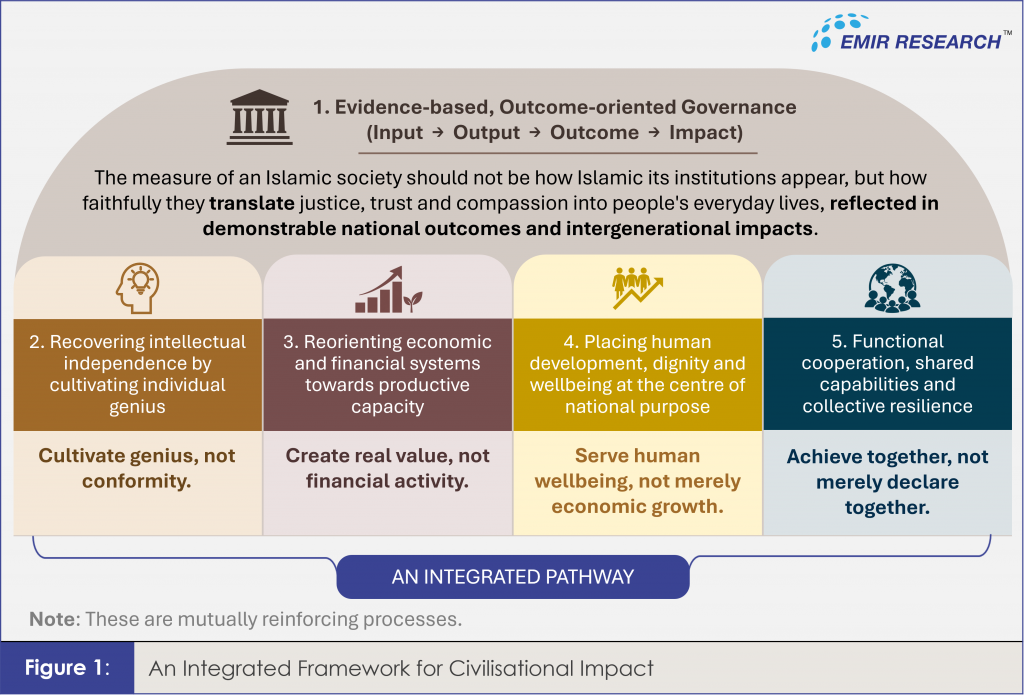
1. Evidence-based, Outcome-oriented Governance
For years, EMIR Research has advocated institutionalising the Input–Output–Outcome–Impact (IOOI) framework in public administration, because the distance between governmental activities and their consequences is often where national resources, public trust and development opportunities vanish.
As argued in our earlier work (see also “Recalibrating National Budget”), development programmes must be evaluated through defensible causal pathways connecting resources and interventions to measurable societal outcomes and, ultimately, intergenerational impacts (Figure 2).
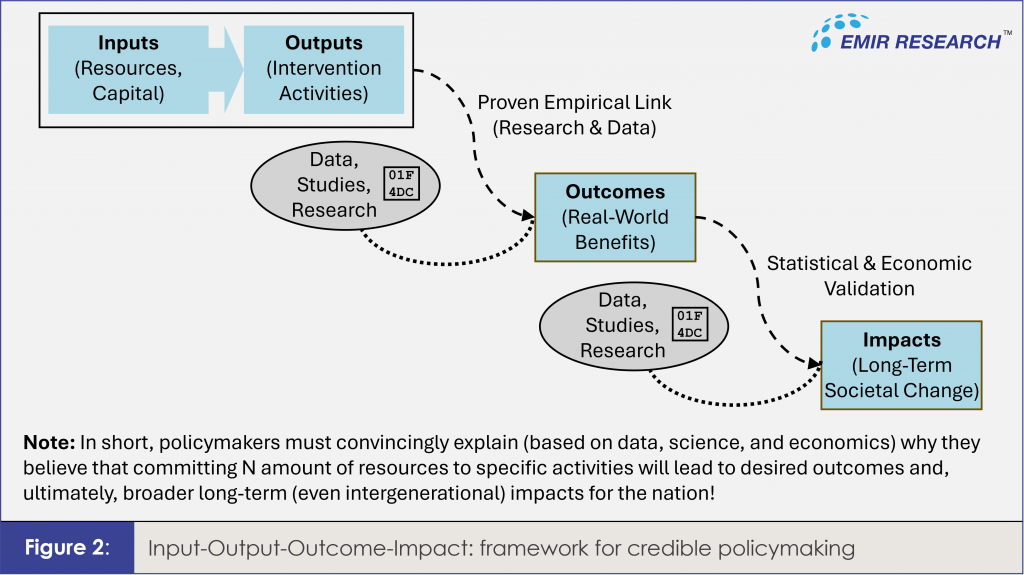
IOOI demands that these relationships be established from the outset, supported by empirical evidence, monitored against meaningful indicators and continuously reassessed as conditions change. It then becomes easier to establish where scarce resources should flow, which interventions deserve priority and which institutions must work together due to their causal interdependence.
This constrains corruption, while a change in political leadership need not mean abandoning existing initiatives merely to introduce new ones. Successful interventions acquire institutional legitimacy through results rather than political sponsorship. This is where the stewardship embodied in the concept of khalifah acquires operational substance.
2. Recovering Intellectual Independence and Cultivating Individual Genius
Muslim civilisation rightly celebrates Al-Khwarizmi, Ibn Sina and Ibn al-Haytham. But we should spend less time merely celebrating and more time examining the conditions that permitted such extraordinary originality to emerge.
What distinguished these thinkers was not merely command of existing knowledge, but the capacity to move beyond its boundaries, develop new explanations and open possibilities previously unavailable. This is particularly urgent with the proliferation of artificial intelligence.
For decades, modern education has largely rewarded standardised performance, conformity to predetermined curricula and efficient reproduction of established knowledge. Foundational competencies must be preserved, but educational success has too often been reduced to producing individuals who perform similar cognitive tasks. We are now developing machines increasingly capable of precisely that type of cognitive uniformity, often with remarkable speed and efficiency.
The response cannot simply be to teach students how to use AI more efficiently, though technological literacy will matter. Education must take seriously the extraordinary diversity of human capabilities, including those that standardised assessments routinely overlook. Its higher purpose should be to help individuals discover what they are uniquely capable of contributing to the world, rather than merely preparing them to fulfil predetermined economic functions.
EMIR Research has argued for educational reform emphasising higher-order thinking, scientific inquiry, interdisciplinarity, individualised attention and the creation rather than mere reproduction of knowledge. In the AI era, this is not only a question of educational quality but of long-term intellectual sovereignty.
Universities, similarly, should be evaluated not simply by publication volumes, research grants or graduate numbers, but by their ability to generate original discoveries, technological innovations and tangible improvements in society. How much research actually advances an industry, solves a persistent problem or improves human life, rather than collecting dust on institutional shelves?
Intellectual dependency may be the most consequential form of dependency, because it compromises a civilisation’s capacity to generate its own explanations, solutions and technological possibilities.
3. Reorienting Economic and Financial Systems Towards Real Productive Capacity
Shariah compliance underpins the religious legitimacy of Islamic finance, but its socioeconomic contribution must also be demonstrable. Yet the industry’s progress is still too often discussed in terms of sukuk issuance, asset growth and product sophistication, rather than the productive capacity these have actually enabled.
How many viable enterprises have been established or expanded? How many farmers have acquired technologies that genuinely improve yields and resource efficiency? How many households have escaped persistent indebtedness and acquired greater economic security? This is IOOI applied to finance.
It also invites a more fundamental reconsideration of the financial architecture itself.
In an earlier article, EMIR Research proposed exploring a Mutual Credit Clearance system, through which trusted participants could record and periodically offset trade obligations, allowing productive exchange with less dependence on external liquidity. Properly designed, such arrangements could help enterprises overcome financing and settlement constraints by making greater use of their existing capacity to supply goods and services. Their feasibility would depend on prudent credit limits, enforceable obligations, effective risk management and careful pilots.
Islamic commercial finance, zakat, waqf and other social finance instruments could likewise be better coordinated around clearly defined socioeconomic objectives, while preserving their respective functions and governance requirements.
4. Placing Comprehensive Human Development, Dignity and Wellbeing at the Centre of National Purpose
Economic growth, technological advancement and institutional sophistication are instruments. Their ultimate justification rests in the lives they enable human beings to lead. This is precisely where maslahah, understood through the broader objectives of maqasid al-Shariah, should become central to national development.
A society may experience impressive GDP growth while many remain deprived of adequate healthcare, meaningful education, economic security or opportunities to exercise their capabilities. A nation may possess advanced infrastructure while neglecting the psychological wellbeing, social relationships and sense of purpose that make life meaningful.
Such contradictions should force us to reconsider what development is. New Zealand’s pioneering 2019 Wellbeing Budget offers an instructive example. As EMIR Research highlighted, the innovation lay not in rhetorically placing wellbeing at the centre of national budgeting, but in reorganising budgetary decisions around the causal relationships between different dimensions of human wellbeing, with explicit attention to intergenerational impacts, consistent with IOOI (“Recalibrating National Budget”).
Ultimately, the purpose of development is not merely to improve the economic conditions in which human beings exist, but to expand their capacity to live with dignity, exercise their distinctive capabilities and find meaning in the lives they lead.
5. Functional Cooperation, Shared Capabilities and Collective Resilience
The Muslim world has no lack of diplomatic forums, ambitious statements or agreements. But there is persistent distance between these instruments and the operational structures required to achieve their stated purposes.
Political differences, economic asymmetries and conflicting national interests undeniably complicate cooperation. Yet there is also a more fundamental institutional problem: we frequently declare collective objectives without constructing the shared causal architecture through which participating institutions can achieve them.
Here again, the IOOI framework offers a transformative organising discipline. Instead of beginning with another declaration of economic solidarity, Muslim-majority nations could identify a limited number of shared, measurable outcomes and work backwards to determine the complementary capabilities, resources and institutions required.
This does not necessitate a rigid supranational bureaucracy. EMIR Research’s previously proposed centre-out governance approach offers a more adaptive model: coordinating institutions establish common objectives, facilitate resources and maintain rigorous standards, while national and local actors retain enough autonomy to adapt solutions to their particular circumstances.
Such an architecture is especially important in the turbulent years ahead, when continuity of purpose must coexist with the capacity to adapt.
These are not five unrelated reform agendas. IOOI provides the organising discipline, intellectual independence and productive finance develop the capabilities, human wellbeing defines their ultimate purpose, and functional cooperation allows those capabilities to acquire collective scale.
Indeed, the central difficulty confronting many Muslim-majority nations may be the persistent substitution of institutional form for societal function. In governance, expenditure is mistaken for effectiveness. In education, qualifications are mistaken for intellectual capacity. In finance, transaction volumes are mistaken for productive economic contributions. In national development, growth is mistaken for wellbeing. And in international cooperation, declarations are mistaken for collective capability.
Yet the defining question often remains insufficiently answered: what has actually changed in people’s lives, and will those improvements endure beyond the present generation?
Perhaps the most consequential reform, then, is to stop treating our highest moral and spiritual ideals as separate from the practical organisation of human life. Justice, compassion, responsibility and the pursuit of knowledge must become the operating principles of our institutions, not merely the values they profess. Our progress should not be judged by how much more we build, spend, finance or declare, but by how much more intelligently we organise our collective potential to enable human beings to flourish.
Dr Rais Hussin and Dr Margarita Peredaryenko are part of the research team at EMIR Research, an independent think tank focused on strategic policy recommendations based on rigorous research.